From Bangor to Beirut - or - DIY Differences Training
Well, yes, I did just do another ferry trip, but just in case anyone is getting fed up of hearing about them, I thought I would introduce another slant to this write up, because I actually got exposed to some new aircraft technology, and although it took a while to get used to it, perhaps the information might come in useful for others, before too long.
The background is that I was asked to ferry a new C182 Turbo from Bangor (the standard jumping-off point from USA to Europe) to Beirut (which rings automatic warning bells for most of us Brits, with the name Terry Waite coming immediately to mind, and enduring TV reports from a war-torn city, back in the early 90s).
The arrangements were made, and I got out to Boston, half way up the road, then a brief overnight stay in a motel, before arriving in Bangor at 0800 local. The aircraft was a beauty – delivery mileage only, pristine condition, and already fitted with its 124 usg ferry tank, leaving little room for much else – except that I had the use of the copilot seat on which to store things in flight. Not only that, I was going to be able to test my home-made “seat-back ferry pouch”, for want of a better name. This was hand-crafted by me, using material similar to that of the children’s dresses in the Sound of Music, and from an identical source (and the end product being every bit as attractive). Should be adequate to contain sandwiches, drinks, tools, approach plates and enroute charts – at least, that is what the design spec said.
The seat-back-pouch, HF radio (on the ferry tank), and O2 controls (in the ceiling)
The fuel truck was called, 181 us gallons ($830 worth) was used to fill it up. I attached a couple of insulators to the LH wingtip and the fin, then ran the HF antenna from the wingtip, via the fin, into the cabin, and into the HF radio. Connected the 24 volt converter, spliced in the 24 volt supply (used to feed the ferry pump), and that was it. Should be airborne in record time.
Now for a quick visit to US Customs, also advise the Canadian authorities (1-888-CANPASS) of my ETA in St. John’s, and that would be it. Wrong. US Customs wanted to know where the aircraft was going. “Only to Lebanon”. Hmm. Couldn’t find the bill of sale – bad start. Then the officer looked at the other paperwork, and said the special category C of A was out of date. They then drove me over to the aircraft, and started searching it. After I contacted the ferry company for “HELP!”, it was explained that the aircraft would remain on the US register, and return to the USA, once it had been used for some corporate flying purposes. At this point, the officer rechecked the C of A, and found he had made a mistake – it was OK all along. He accepted the rest of the info presented to him, and stamped up my docs, so I finally got to the aircraft, quite late.
Flight 1. Bangor to St. John’s, Newfoundland
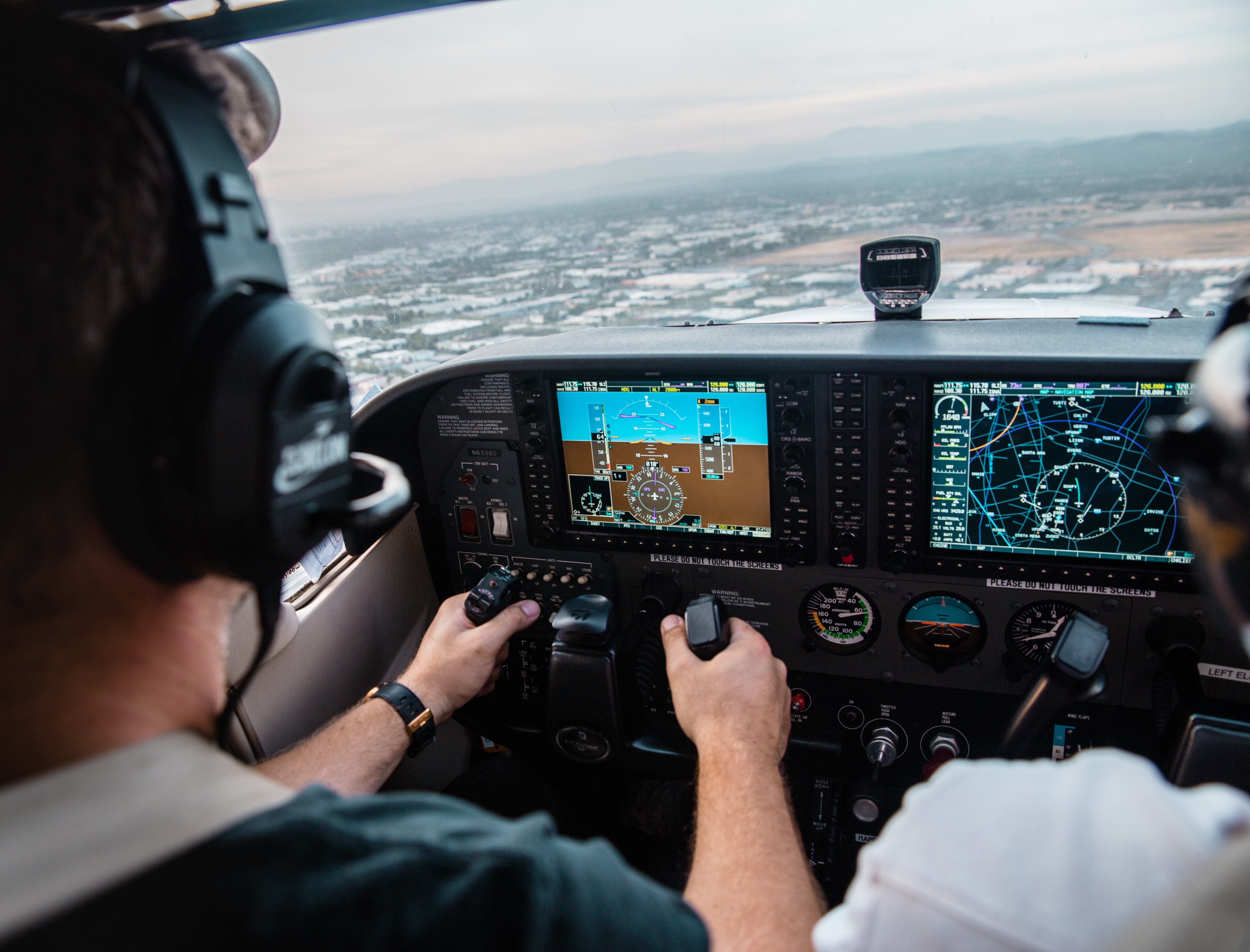
I needed to get the show on the road, but had no time to familiarise myself fully with the Garmin 1000 glass cockpit of this aircraft, which I have never used before. After 20 minutes of engine running, and knob twiddling, my skill level was sufficient to be able to monitor the basic engine parameters, and use the radios. I still had three old friends available - proper Attitude Indicator, ASI, and Altimeter (classed as “standby” instruments). Eureka! Enough to get airborne – I should hopefully learn a bit during the 5 hour cruise to St. John’s, Newfoundland. Called for taxi, used the checklist very carefully, and finally got airborne.
Played with the toys en-route, and started to get an insight into the operation of everything. The fuel tank management was basically – use mains, until showing ¾ full, then switch to the ferry tank. The engine continued to run, and over a period of time, the mains started to fill up. From this I deduced that the ferry fuel must be pumped into the mains, at a rate which only slightly exceeds the normal burn rate anyway.
Landed at St. John’s, taxied into the Fixed Base Operator, and prepared to meet my doom, with the Canadian Customs officials. I was 2 hours late, partly because of me dithering on the apron, learning the rudiments of the systems before departure, and partly because I had been lead to believe the aircraft was much faster than it was, and finally, because the headwinds were stronger than I had anticipated. Last time I was in this situation, the officer made it clear that I should have let them know the ETA was different, and – don’t ever do it again! So, I called CANPASS, declared that I had arrived, very late, and sat back to wait for the explosion. Thankfully, the guy was happy to give me a good telling off, but he didn’t ground me, and force me to wait until I had been rebuked in person by one of his colleagues. But – “Don’t ever do it again!”
Another potential problem that had arisen during the call with the Canadians was that, according to their database, this aircraft had not been cleared by Transport Canada for transit/overflight, and I was liable to a fine, if I tried to leave the Canadian shores without it. Fortunately, no-one came to do a ramp check (it was the weekend!), so enough said.
Flight 1 - Lessons learnt
- There are two large, identical displays – however, they certainly don’t display the same information.
- The aircraft has a main and a standby battery, and during the start procedure, the standby battery must be tested, then “armed”. The standby battery is obviously there for redundancy, since a single electrical system failure would deprive the pilot of all the essential information that was previously presented by mechanical gauges.
- On startup (with both avionics busses “off”), only the pilot’s display is alive, and shows engine information, and radio, nav frequencies
- After the avionics busses are turned on, the LH display (PFD – Primary Flight Display) shows things like attitude indicator, HSI, VSI, Altimeter, etc. But these are presented in a user-friendly, but very alien, manner. Now all the engine instrumentation has slipped quietly across to the RHS. Fooled me for a minute or two, but then I got the hang of looking at Manifold Pressure, RPM, Fuel Flow, and EGT, CHT over the other side.
- The colour moving map occupies most of the RHS, and there were the usual GPS buttons to allow “Go To”, and Zoom in/out. What a great relief! This little beauty had an international database, so I could punch in the designators for the airports, waypoint, VORs, without a problem.
Flight 2. St. John’s to Santa Maria, Azores
I knew that I would naturally wake up early in the hotel, so didn’t bother to set the alarm – I would sleep as much as my body would allow. Big mistake. Overslept by about 2 hours, so a bit of a rush ensued, and didn’t have much of a breakfast, although I had provisions in the cockpit. Got the Atlantic weather briefing, Notams, filled in the flight plan (Flight Level 110), fuelled up, and departed.
Well, I got up to FL 110 OK but I still was struggling with the finer points of the GPS, and I couldn’t insert the Lat/Long info that I needed. Fortunately, I had my ancient portable Magellan, so I would have to use that, initially. The temperature was -3, and sure enough, there was cloud at this altitude, and sure enough, it started to pick up ice. At this point, I called Gander on the VHF and requested descent to FL090 for a while. He was not happy, since the minimum approved flight level was actually 110, but I explained that I was having problems with my navigation equipment, AND picking up ice, and I really wanted only one problem to fix at that time, not two. I would call him when I was sorted, and request a return to FL 110. I duly got the LAT/LONG programmed for the whole route, and by that time, the cloud had gone anyway, so it was no problem.
The only problem that I had was that there was no mic for the HF radio! In my rush, I didn’t notice that the mic socket was a multi-pin affair, not the normal headset type, as I had assumed. This is because the radio can be mounted remotely, and the mic has switches to step up/down through the various published channels, without straining to reach the controls on the radio itself. Shame, because the reception was the best I have ever heard.
The rules for crossing the Atlantic on that route are that an aircraft must be equipped with HF radio. Technically, I was. So, I continued regardless, and was able to get VHF radio relays on 123.45 or 121.5 from other big guys – Aero Mexico, Iberia, and one or two others, for my mandatory position reports.
The ferry tank continued to be used on a cyclic basis, so as to keep the mains between 75 and 90% full. Then, towards the end of the flight, there was a hiccup. The engine coughed, twice, and started to lose power, so I immediately switched to the mains, and didn’t use the ferry again. Because the autopilot was in “Altitude Hold” mode, the poor thing tried to retrim nose up, to maintain height regardless of no power. At the same time, there was a male voice saying “THE TRIM IS IN MOTION!” I felt like saying “Yes, I was nearly in the same situation for a second”.
Why did the engine stop though? I eventually realised that my previous assumption was wrong. The ferry tank didn’t feed the main tanks at all – only the engine. The reason the main tanks started to fill up is because the engine driven fuel pump supplies fuel at a rate greater than required for cruise (i.e. sufficient for full power climbs), and the SURPLUS fuel must be vented back to the mains. Mystery resolved.
Arrived at Santa Maria more or less on time, cleared immigration, and went for a meal, and bed.
Flight 2 – Lessons learnt
- The engine instruments are far more comprehensive than I first realised. By pressing the appropriate button, it was possible to monitor the CHT and EGT for each of the 6 cylinders.
- Until this point, I had been using the TIT (Turbine Inlet Temperature) gauge, keeping it at about 80% of the green band using the mixture control, but the little explorations with the buttons showed that this, and the Fuel Flow, could be accurately measured, with digital readouts, instead of analogue.
- The Heading Indicator could be displayed in various modes – CDI, OBS and HSI (I think).
- The two VOR frequencies can be selected, and displayed simultaneously on the Heading Indicator (with different representation for each). Still, the Go-to button on the GPS worked well, so no need to bother with those at the moment.
Flight 3. Santa Maria to Jerez, Spain
Sunday morning, got a lift to the airport, and prepared for the flight. Found out (remembered?) that the fuel guy doesn’t take credit cards, only cash or carnet. Fortunately, I had $500, and a few euros. Fortunately, I had two credit cards, and there was an ATM in the terminal building. Unfortunately, it only dispensed 200 euros for any one card, so I JUST managed to pay him, and have VERY small change left.
My intention was to route to Jerez, my home base, and have Eileen pick me up on landing, so that I could at least have the luxury of sleeping in my own bed, before the next leg. The flight plan was submitted, but came back highly modified, with a lousy routing, taking me up into Portugal, then Seville, before turning south to Jerez. Out of VHF range for quite a long time, but eventually made contact with Lisboa, and asked them to please find a better route – I gave them some suggestions. They agreed, and thereby shaved at least half an hour off the route time. It was SO nice to be able to talk to the familiar controllers, and land at my base airport.
Primary Flight Display, showing Attitude Indicator, Air speed indicator (with colour coded bands) (bottom box is TAS indicator), Altimeter (top box is autopilot selected altitude, bottom box is the pressure setting), Vertical Speed Indicator, HSI display, with CDI, VOR Relative Bearing Indicators, confirmation of navaid ident, symbol used to depict Nav 1, DME distance, Inset, showing aircraft heading and wind vector, Transponder squawk code.
Right Hand screen, showing basic engine parameters, and colour map display
Flight 3 – Lessons learnt
- The VORs worked a treat – not only that, they actually display the ident on the screen! Still need to ident it aurally though – old habits die hard.
- The Garmin 1000 has a built-in stormscope. I displayed the page, but since there were no clouds, there was nothing of interest to see.
- It also has the capability to download real-time weather. But, the subscription had not yet been paid, so there was just a warning message stating that it was not available. Again, nothing to see.
- I have been told there is a kind of “poor man’s TCAS” available also. If so, it was not enabled.
Flight 4. Jerez to Malta
Bad news. When I first heard that the trip was on, I phoned the Aerad people in Stockholm, to get the appropriate enroute charts for the remaining legs, and the approach plates for Malta and Lebanon. They confirmed that they would be with me by the end of that week. They hadn’t arrived! And today was 1st May, a bank holiday, so no chance of getting them in time.
My first call was to the UK ferry company, to say – please scan the necessary charts and plates, and email them to me, otherwise, there could be delays. “Difficult”, the man says. The guy who would man the office, where the info was kept, would be at the mercy of the bank holiday bus schedule, and might not be in till quite late in the day. Oh well – do what you can.
I phoned up IFPS in Paris, who are responsible for processing IFR flight plans for this area, and explained that I needed to get an acceptable route, in the system, but it would be a while before I could get any charts. Help! They were great. I was told – just route Jerez – direct – Malta, and they would look out for it, tweak it, and send it back with an acceptable route. They did exactly that – although it seemed a bit of a round-the-houses route.
The staff in Jerez ATC were also very helpful, they lent me their charts for the few days that I would need them. The problem of no approach plates wasn’t too serious, because the weather was forecast to be VFR for the remaining trip, and anyway, I would normally expect radar vectors to final approach. The thing that made me feel confident enough to depart was the fact that the Garmin 1000 has this fantastic database that can be called up, to give all the required info for any airport, including the frequencies, and airport diagrams.
Again, the Jerez refueller could only supply fuel for either cash or carnet, so drew yet more dosh out of the hole in the wall machine - just enough to cover the filling of the tanks.
So, I departed with sufficient information, albeit rather later than I had hoped. The routing was initially towards Malaga, then inland (passing some of the highest ground on the whole route), up towards Valencia, Barcelona, and across to the east, and eventually passed just south of Gozo, for a landing at Luqa.
The handling agent was awaiting my arrival, also the refueller (who did take a credit card, thank goodness) and organised a taxi to my hotel, and a pickup the next morning.
Flight 4 - Lessons learnt.
- I played around with the nav display, and got the colour-coded maps to show up beautifully.
- There was a feature that monitored the altitude, and the nearby terrain, and would alert, when the terrain clearance was inadequate. At least, that is my understanding – the flight plan route for FL110 was validated by Eurocontrol to ensure minimum IFR separation requirements, so it never kicked in.
GPS Map, showing high ground to the left
The view out of the left window
Flight 5. Malta to Beirut
Checked my email, and was relieved to find that the approach plates for Beirut had been sent. Printed these, and at last, felt properly prepared for the final leg.
I submitted the flight plan, with the all-important Beirut clearance number specified in the RMK/ section, and set off for a very pleasant flight, in good VMC conditions, to the final destination. Even so, I half expected political problems, going into an Arab country with a US registered aircraft, and had deliberately fuelled up with plenty of reserve fuel, to get me back to Cyprus, in the event that I got refused at the last minute.
As it happens, there was no problem, other than the fact that the Approach Controller started to give me radar vectors for one runway, then changed his mind, causing me to do a lot of manoeuvring, by now in haze. I remained at the previously cleared altitude, while I was still picking up the salient details of the new approach, and by the time I regained the correct localiser path, I realised what the DME was showing. Sure enough, I was way too high for a normal approach, so I asked Tower for a 360 on final to allow me to lose height. This did the trick, and once clear of the runway, I trundled after the Follow Me vehicle – passing a bunch of people stood outside a large hangar, waving furiously – sure enough, the driver was confused, overshot, and had to do a 180 to take us back to the welcoming party.
Right Hand screen, showing the programmed routing, and attempting to show real-time weather (but not enabled)
I was royally welcomed, met the new owner, and was immediately told that I had been booked in for two nights in a rather nice hotel, at his expense. To cut a long story a little shorter, I was also given the use of a car and driver, available 24 hours, met up with the owner and his friends and guests both evenings, and enjoyed some of the best food I have ever eaten. I had never tried Lebanese food until then but it really was excellent (apparently there are at least 4 Lebanese restaurants in London, that do a roaring trade).
Beirut Airport – handing over the keys to the new owner
At most tables in the restaurants, people were there smoking from these strange devices with a long hose, glass bubbles full of water, and some stuff burning on top. I asked my host what were they smoking? He said I would be surprised – apple! When I got home, I tried to impress Eileen with this new-found knowledge. She simply said “You’d believe anything!”
Flight 5. Lessons learnt
- I finally figured out how to string together a bunch of waypoints, to make them into a route, which the autopilot could then follow for hundreds of miles, turning over each one, without any further command from me. I would have cracked this earlier, except the buttons I was pushing were the obvious ones. The critical one was in the middle of the concentric knobs, used to step through menus and sub-menus.
- At one time I was beginning to doubt that the aircraft could display ILS information – where was the glideslope indicator?? However, during my descending 360 on final approach, I waited for the PAPIs to show the right combination of colours, and sure enough, there it was, right in the middle of the vertical scale – a bit non-obvious when I was at full scale GS deflection.
- Differences training – it actually makes a lot of sense. I was lucky enough to figure it out empirically, but only because I had an easy trip, in good weather, for long periods, with a fantastic autopilot doing the work. I could have learnt the same things, in a fraction of the time, if only I had been able to use the services of a good instructor. My way was fun, it helped beat the boredom – but training would have been 10 times more efficient.